
Ready For Risk
The Basic Defensive Response Immediate Action Drill For Every Day Defenders and Pros

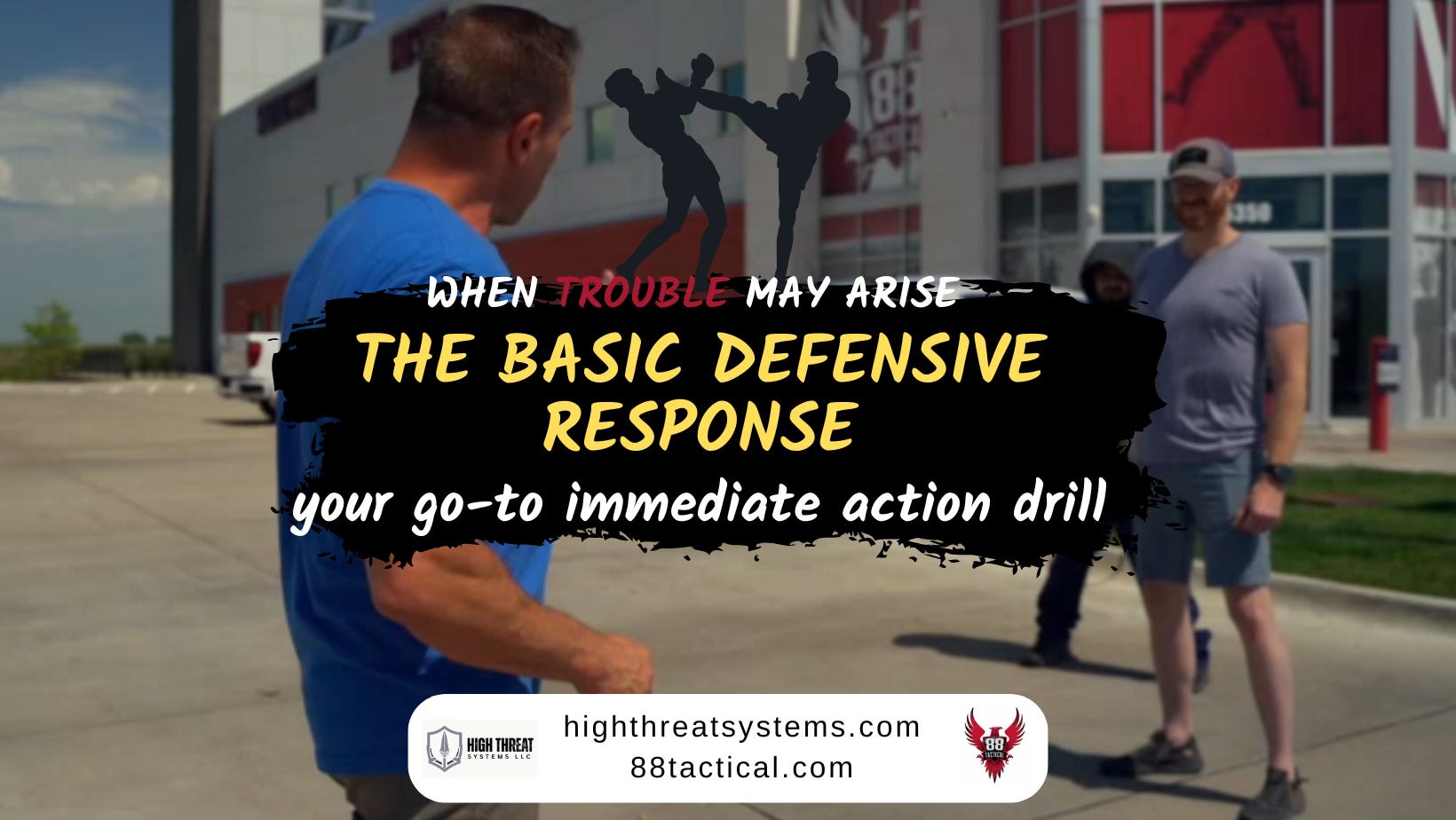
Master the Basic Defensive Response: Your Everyday Survival Plan
In today’s chaotic world, staying safe requires taking proactive measures before danger strikes. As someone who has trained thousands through simulations and carefully observed thousands of violent encounter videos, along with having had more than my share of encounters, I have witnessed how a simple, intuitive response can turn the tide of a situation. Whether you’re pumping gas or walking downtown, being a good witness, or find yourself under fire, this concept serves as your battle drill to put the odds in your favor and get you ready to respond. Keep in mind, this defensive response is an option; there are times to go more offensive, but I have found this basic drill will enhance survival in the majority of situations. Let’s delve into the details.
Get Off The “X”- Move!
Criminals pick their moment and place—call it their “X”—where they think they’ll win. They have chosen the place they want you to be for an attack, just like “Wile E. Coyote” and the Roadrunner, and this place makes their attack more likely to be successful. Your first move is to get off that hotspot. A quick sidestep or a few feet can disrupt their plan, forcing them to react as you seize the initiative. Don’t stay where they want you pinned.
Get Some Distance
Being too close is one of the most common deadly errors for everyday defenders as well as police officers. Putting space between you and a threat gives you precious seconds to think—whether to run or prepare. It’s about buying time to give you options and a better response, as I’ve emphasized in training drills. I’ll have an article on specific distances, what they mean, and why, as well as how you can leverage them for an advantage, soon.
Get Something Between You - Seek a Barrier
Use the environment or objects to shield yourself—a car, your bicycle, a table, a bush, or even your hands to block an attack. A barrier may be cover that stops bullets, concealment that stops sight, or an obstacle that slows or hinders movement. Almost anything is better than nothing. It can not only make the attack less effective, but the combination of distance and obstacle could cause them to abandon their plans. Additionally, the barrier may block your hands as you ready a defensive tool. In an ambush, getting to cover can nearly double your survival rate. (IACP Ambush Fact Sheet, 2011)
Spot All Threats - Keep Them All in One Field of View
Never assume it’s just one danger. Remember the “Plus One Rule,” expect another attack, another attacker, and another weapon. Always scan for a second attacker—someone might distract while another moves in. Keeping all threats in view, a tactic I drill in numerous courses, usually involves lateral movement —shifting left or right — to keep as many potential threats and danger areas as possible in your primary field of view. This movement also easily allows you to check your six, or what was previously your back, with a quick turn of the head. Threats hope to draw your attention while another attacks from the rear.
Manage Timing, Talk, Tools, and Tactics
Once you are positioned, or are on the way, decide your next move. A firm “Stay back!” can deter, or you might reach for pepper spray, keys, or a firearm if the law allows. Timing is critical—act with purpose, not panic. Speed is great, but acting early and having good timing is typically more critical. Of course, be careful of bringing out tools too soon; unreasonable brandishing could cause trouble, or too late; it can get you killed.
Incidental Training Opportunities (ITO)
Seize Incidental Training Opportunities (ITO) to embed the Basic Defensive Response into your daily life, whether overtly or covertly, depending on the situation. Incidental training opportunities can arise in your day-to-day life, whether you're truly under threat or simply as a chance to practice a skill. The more you can execute this drill and the more frequently you can execute it in a realistic context, the better you will be at performing it on demand when the chips are down. Repetition, recency, and familiarity are all key. At the gas station, use a shady approach to practice moving off the “X” with a bold sidestep, or subtly shift your position at the store to gain distance. When walking down the street and you see trouble ahead, execute.
A Few Real-World Examples
Below are two interesting examples. You will see that, as is the case with any response, mindset and awareness are the key to getting your immediate action drill into play:
Man Uses The Defensive Response and Gas Pump To Spray Robbers
Unaware Victim Gets Beaten At Gas Station
